







Sign up here to receive The Yappie's weekly briefing on Asian American + Pacific Islander politics and support our work by making a donation.
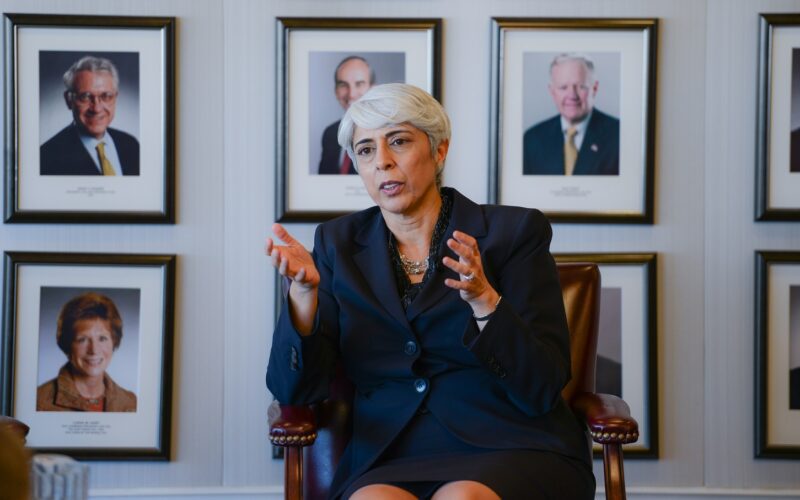
The Senate voted 56-40 to confirm Arati Prabhakar as director of the White House Office of Science and Technology Policy (OSTP) on Thursday, three months after President Joe Biden nominated her.
Prabhakar, who is Indian American, becomes the third Asian American member of Biden’s Cabinet, alongside Vice President Kamala Harris and U.S. Trade Representative Katherine Tai. She is also the first woman and first person of color to serve as a presidential science adviser.
As director of the Biden administration’s OSTP, Prabhakar will oversee federal technology usage and research for the U.S.’s COVID-19 response, climate action, racial equity, and other key priorities. She will also serve as Biden’s chief advisor for science and technology and co-chair Biden’s Council of Advisors on Science and Technology.
Biden elevated OSTP, first established by Congress in 1976, to a Cabinet-level agency in January 2021. The agency now ranks alongside the executive departments including the Departments of Agriculture, Defense, and Education.
Prabhakar previously served as director of the Defense Advanced Research Projects Agency (DARPA) under former President Barack Obama. She also led the National Institute of Standards and Technology (NIST) under former President Bill Clinton.
After graduating from California Institute of Technology with a doctorate degree in applied physics in 1985—the first woman to do so at the elite research university—Prabhakar helped shape policy around technology investment as a congressional fellow and later as a program manager at DARPA, overseeing research into the semiconductor technology that power today’s computers.
Prabhakar will replace social scientist Alondra Nelson, who has served as the acting director of OSTP since Biden’s first director, human genome researcher Eric Lander, resigned in February after POLITICO reported on an internal investigation that found Lander “bullied and demeaned his subordinates.” The two-month investigation first started after an OSTP attorney filed a complaint alleging that Lander demoted her as an act of retaliation.
Lander had also previously faced controversy for writing a history of the gene-editing CRISPR technology that erased the contributions of Nobel-prize winning women scientists Emmanuelle Charpentier and Jennifer Doudna, and for celebrating James Watson, a scientist who espoused racist and sexist views.
In contrast, AAPI advocates and officials celebrated Prabhakar’s appointment as a historic step forward.
“Throughout her career, Dr. Prabhakar has helped gather and develop new ideas, and implement solutions to some of today’s biggest challenges: climate change, healthcare, and data security," Varun Nikore, executive director of AAPI Victory Alliance, said in a statement Thursday. "In her new role, we are confident that she will only further her legacy of ground-breaking work, and continue setting a leadership example for all women of color—especially AAPI women—in American government.”
“I am also thrilled to see a South Asian American woman joining the President’s Cabinet,” Rep. Judy Chu (D-California), chair of the Congressional Asian Pacific American Caucus, said in a statement when Prabhakar's nomination was first announced. “This nomination [is] not just a phenomenal choice, but one of historical significance.”
Correction: A previous version of this article misspelled Emmanuelle Charpentier's name.
Editor's note: This story has been updated to include Varun Nikore's statement after the confirmation.
The Yappie is your must-read briefing on AAPI power, politics, and influence, fiscally sponsored by the Asian American Journalists Association. Make a donation, subscribe, and follow us on Twitter (@theyappie). Send tips and feedback to [email protected].
