




Sign up here to receive The Yappie's weekly briefing on Asian American + Pacific Islander politics and support our work by making a donation.
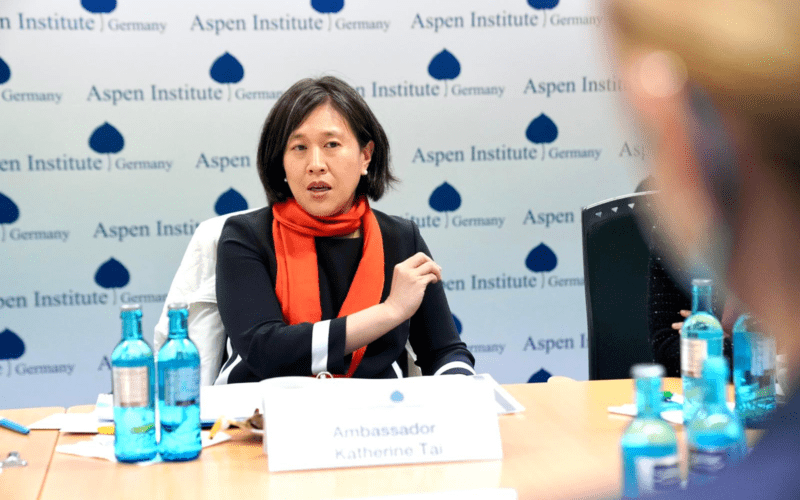
A few weeks ago, I had the chance to speak with U.S. Trade Representative Katherine Tai in her office in Washington D.C. Tai, a Chinese American, oversees trade policy in a time of fierce U.S.-China competition and surges in anti-Asian hate. She is the only Asian American at the Cabinet level besides Vice President Kamala Harris.
In our interview, first published in Axios, Tai speaks about the challenges in her position, homing in on the actual problems, and how her identity shapes her work on China.
Q: How do you navigate the tricky position as an Asian American given the increased scrutiny and the issues that dominate your portfolio, mainly China?
It's something that I have to navigate that maybe previous USTRs … have not had to navigate.
I've worked in trade policy for 15 to 20 years. I've been involved in the U.S.-China, part of the trade policy to a very large degree for all that time … It's not anything that is new to me. So in some ways, as hard as these issues are for anyone and as hard as they are for someone like me with my background, it is in many ways, I think, the culmination of everything that I have studied and all the work that I have done.
I was in Scotland, and there was a member of the British trade team, and his family is of Chinese origin. And, you know, I made eye contact with him. And it was in the hallway as we were walking out. And he said, "Ambassador, I just want to let you know that, for the first time in my life, my mother is interested in what I do in trade policy, and it's thanks to you."
Q: Covering these issues and wanting to make sure that we are fair on covering the Chinese government's human rights abuses, but also not using inflammatory rhetoric around China—what's your take on how we should be approaching that?
When you're steeped in the policy and the substance, that gives you the ability to focus on and to define what the problem is. The problem is not Chinese-ness. It is not Asian-ness … Having the background that we do means that we are more equipped to focus on the real substantive issues and to filter out the noise.
Q: What have you heard from Asian Americans who are concerned that these growing tensions between two countries will impact their job security, whether that's in an American company or Chinese company?
The conversations that I've had with community members from the AANHPI community — they're feeling [the tensions] a lot. And it might be because they're working specifically in this area, or because of their connections in their relationship to the region. When that relationship is under tension, they are the communities that will feel it the most. But … they get the challenge that we have, and they get the need for a rebalancing in this relationship that puts this relationship on more solid footing.
This conversation has been edited for length and clarity.
The Yappie is your must-read briefing on AAPI power, politics, and influence, fiscally sponsored by the Asian American Journalists Association. Make a donation, subscribe, and follow us on Twitter (@theyappie). Send tips and feedback to editors@theyappie.com.