






Good morning and welcome to The Yappie’s Asian American + Pacific Islander politics briefing. If you’re attending #AAJA21, come say hi! Otherwise, send tips and feedback to [email protected], apply to join our team, and support The Yappie‘s work by making a donation.
The Big Story
DEEP DIVE—HAWAIʻI’S TOURISM CRISIS: For months, Native Hawaiians have expressed frustration, anger, and helplessness as tourists return to the islands in droves—despite surging Delta cases around the world. Their fears are backed by numbers: COVID infections among Native Hawaiians and Pacific Islanders (NHPI) spiked in July, and Hawaiʻi’s death toll is now its highest since vaccines became available, reaching a record high of daily cases on Aug. 11, Hawaii News Now reports.
This week, Hawaiʻi Gov. David Ige (D) publicly echoed their pleas, begging would-be visitors to stay away. The rare show of unity between Indigenous activists and the governor, who previously clashed over the Thirty Meter Telescope’s construction on sacred lands and related issues, highlights the severity of the public health emergency facing the state.
How we got here: After a recent water shortage led officials to enact emergency restrictions, Native Hawaiians called out tourists for using up resources and forcing locals to make sacrifices. “Stop coming to Hawaiʻi. They are treating us like second class citizens, literally cutting off our water to feed over-tourism,” former state lawmaker Kaniela Ing tweeted.
Major racial disparities in COVID’s impact have magnified the alarm. Pacific Islanders make up only 4% of the population but account for 21% of COVID deaths in Hawaiʻi. The likelihood of a Pacific Islander dying from COVID is almost four times higher than any other ethnic group, according to data from the state’s Department of Health. Since July, Native Hawaiians have also comprised as much as 27% of newly reported cases, per the Honolulu Civil Beat.
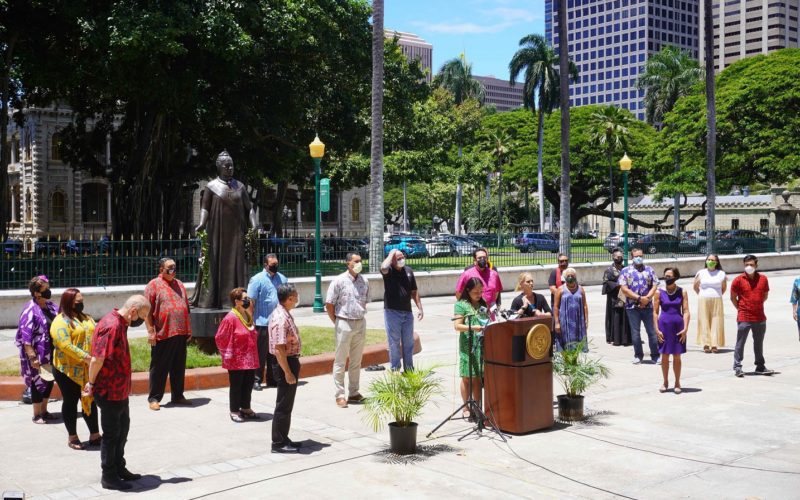
On Thursday, 23 Native Hawaiian leaders gathered at the state capitol to urge their community to get vaccinated. “The consequences of this pandemic are devastating and we must take action now to protect our future,” said Diane Paloma, chief executive officer of the King Lunalilo Trust and Home. Just 18% of NHPIs in Hawaiʻi have gotten the vaccine, compared to 52% of Asians and 26% of white people, per state health data.
A combination of health, language, and cultural barriers have held NHPIs back. A survey released in May found that 43% of NHPIs ages 18 to 44 are hesitant to get the vaccine due to distrust of the U.S. government. At the time, NHPI COVID death rates were the highest in D.C. and 11 of the 16 states reporting the demographic’s mortality data.
Don’t forget: Native Hawaiians have fought for years to reclaim sovereignty over the Hawaiian Kingdom, which collapsed when American colonizers forcibly overtook the islands and decimated the Indigenous population. To some, Hawaiʻi’s reliance on tourism is a direct result of colonialism—as is the current surge in NHPI cases and deaths.
“Hawaiʻi has been portrayed as a paradise and an escape from reality for so long that of course people want to come here to forget their troubles,” Camille Leihulu Slagle, a Native Hawaiian from Oahu, told Teen Vogue. “They’ll leave Hawaii with happy memories, but they won’t think about the harm they might have caused to the people who actually live here.”
The Biden Era
ON OUR RADAR— Vice President Kamala Harris confirmed Thursday evening that U.S. military-led evacuations will continue out of Kabul airport, hours after 13 American troops and at least 60 Afghans were killed in ISIS terror attacks in Afghanistan’s capital. Harris returns to D.C. Friday following her trip to Asia, where she rebuked China’s “bullying” in Southeast Asia.
ACTIVISTS WARN BIDEN ON COVID REPORT: Federal intelligence officials’ 90-day probe into the origins of the coronavirus found inconclusive results, the Washington Post reports. The administration is expected to release an unclassified version of the report in the coming days.
- Why this matters: Last week, 23 AAPI civil rights groups urged the administration to take extra caution around the investigation, warning that the "simple existence of that report will put our communities at risk” and potentially fuel an increase in anti-Asian violence, Axios’ Shawna Chen notes.
- Context: Stop AAPI Hate has received 9,000+ reports of hate incidents since March 2020, with nearly half including anti-Chinese or anti-immigrant rhetoric.
- On the Hill… "The administration must make every effort not to fuel this hate, starting with clear and specific language and continuing its condemnation of violence against the AAPI community," Sen. Mazie Hirono (D-Hawaii) tells CNN’s Nicole Chavez.
UPDATE—AAPI ORGS SEEK GREATER WHITE HOUSE ENGAGEMENT: Following AAPI voters’ critical turnout in the 2020 election cycle, activists tell the National Journal’s Dylan Wells that the Biden administration must do more to incorporate AAPIs into the push for federal voting rights legislation, arguing that it would not be possible to “out-organize” GOP-led states’ restrictions.
- Meanwhile… House lawmakers voted 219-212 on Tuesday to pass the John Lewis Voting Rights Advancement Act over GOP opposition, earning praise from advocacy groups like APIAVote—though the measure faces slim odds in the Senate.
- Catch up quick: President Joe Biden and Vice President Kamala Harris met with more than a dozen AAPI civil rights leaders on Aug. 5 to discuss issue priorities such as voting rights, immigration, and data disaggregation. The Yappie’s Javan Santos has more from the White House.
ICYMI—WHAT WE LEARNED FROM THE 2020 CENSUS: AAPI groups can dust off their talking points and reuse them for another decade. Asian American, Native Hawaiian, and Pacific Islander communities continue to grow rapidly, according to long-awaited data released by the U.S. Census Bureau—with Asian Americans remaining the fastest-growing racial and ethnic group in the country.
- The soaring Asian population has “become geographically diverse with wide variations in income, citizenship status and political preference,” the New York Times reports.
THE LONG READ—Many Vietnamese refugees who came to the U.S. after the fall of Saigon say it’s crucial for the government and everyday citizens to welcome Afghan families fleeing the Taliban, Insider’s Kristie-Valerie Hoang reports.
AAPI Nation
NUMBER OF THE WEEK—66: That’s the percentage of Asian Americans who support making four-year college or university education free for all U.S. citizens, according to an Axios/Ipsos poll.
Here’s what else is happening across America…
- From New York City to San Francisco, AAPI advocates are serving as bridges to a new era of community-building. The Yappie’s Samson Zhang tracks the efforts of several groups, including Soar Over Hate and the Bay Area Chinatown Safety Patrol.
- Time's Up President and CEO Tina Tchen has resigned following new reports on the advocacy group’s relationship with former New York Gov. Andrew Cuomo (D).
- Minnesota GOP Chairwoman Jennifer Carnahan, one of the Republican Party’s most prominent Asian American leaders, has stepped down amid controversy over her ties to a donor accused of sex trafficking minors.
- Republicans in California are urgently rethinking their approach as they lose ground with Vietnamese Americans, who were once among the party’s most reliable constituencies, POLITICO’s Catherine Kim reports.
- With the 2022 Maryland primaries approaching, politicians and party officials are increasingly turning to AAPI voters as key to future elections, the Washington Post’s Stephanie Lai notes.
- 70% of AAPI women voters ages 50 and older have experienced anti-AAPI hate, according to a new study from the National Asian Pacific American Women's Forum.
- New York City’s Asian American Federation and local lawmakers are calling for more state resources as the number of anti-Asian attacks continues to climb.
- Virtual learning, anti-Asian hate, and anxiety over family well-being is fueling stress and anxiety among Filipino American college students, CNBC's Annika Kim Constantino writes.
- Vicha Ratanapakdee’s death became a symbol of grief and reckoning over anti-Asian violence. But Jaeah Lee writes that his family is still grappling with unresolved questions.
- Though states that track Pacific Islander vaccination rates report high numbers, organizers say Pacific Islanders remain hesitant about getting the vaccine due to rampant misinformation.
- Represented by the Asian American Legal Defense and Education Fund, a Bangladeshi American has successfully sued a Michigan city over its failure to provide Bengali language information and assistance in compliance with the Voting Rights Act.
- Honolulu City Councilwoman Andria Tupola is calling on local police to create a language access unit after a report found that the department employs few language interpreters for Pacific Islanders—even though they comprise a disproportionate number of arrests and often speak English as a second language.
- Reliance on data that treats AAPIs as a monolith has hurt vulnerable AAPI communities and masks stark inequities, according to Bloomberg’s Amy Yee.
- The University of Hawaiʻi at Mānoa is embarking on a $15 million public impact project to research the practice of hula and its effect on vascular risk factors for Alzheimer’s among NHPIs.
- Finally… A new generation of bakery owners is creating sweets that allow “young and intrepid Asian Americans to celebrate their dual identity,” the Associated Press’ Terry Tang writes.
Enjoying The Yappie? Make a donation, forward this briefing to a friend. or subscribe here. You can also follow us on Twitter, Instagram, and Facebook.