






Sign up here to receive The Yappie‘s weekly briefing on Asian American + Pacific Islander politics and support our work by making a donation.
Rep. Pramila Jayapal (D-Washington) was struggling with postpartum depression and fighting for legal status in the U.S. when she became pregnant again. It was one of the most difficult periods in her life. For her, abortion was the only option, she told her fellow lawmakers in a September House committee hearing.
An immigrant from India, she said she had limited support from family—her mother didn’t even know about her abortion until she disclosed it publicly in 2019.
“Some of it was because as an immigrant from a culture that deeply values children and in a society that still stigmatizes abortion, suicide, and mental health needs, I felt shame that I never should have felt,” she said, her hands folded.
Research has proven that Asian American and Pacific Islander (AAPI) parents often feel discomfort discussing sexual health with their children. In a study of 455 AAPI respondents ages 18 to 25, only 10% reported family as a source of sex and birth control education, according to a paper published in the Journal of Immigrant and Minority Health.
As a result, one in three Asian women prevent pregnancy by using the unreliable calendar method—predicting ovulation time by tracking menstrual history. AAPIs use this method at twice the rate of other racial groups, per statistics from the Centers for Disease Control and Prevention.
“Unfortunately many AAPI women do face cultural stigma around the choice to have an abortion,” said Jayapal in an interview with me.
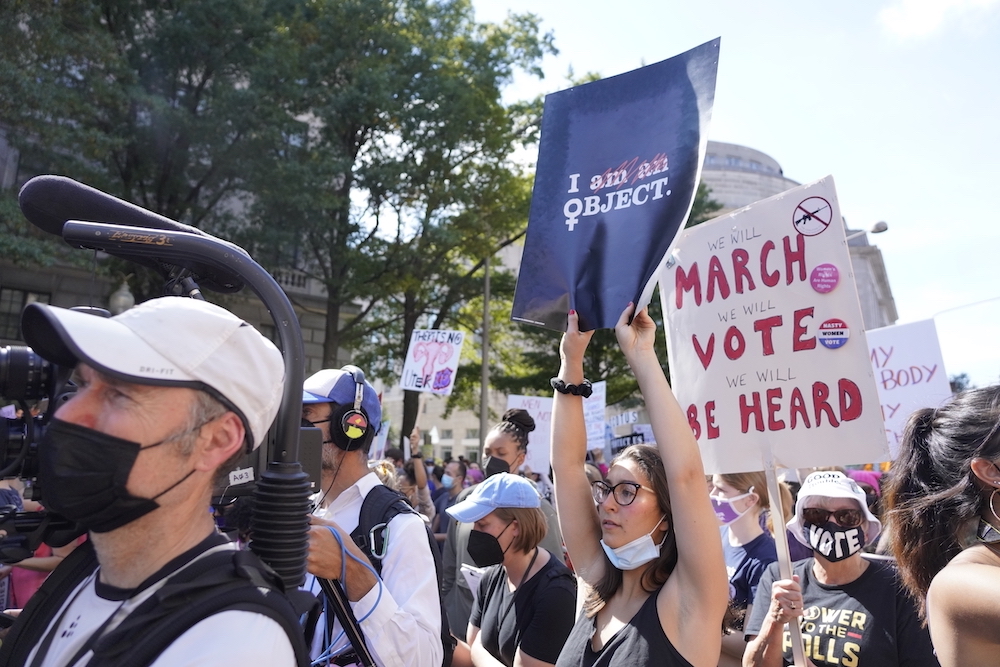
As GOP-led crusades codify abortion bans across the country, AAPIs are fighting for their right to choice—the right to ownership over their bodies.
A new reality
The Supreme Court heard roughly three hours of arguments over Texas’ controversial abortion ban last week. To many’s surprise, several members of the high court, even conservative justices, voiced concern about the restrictive law.
Under SB8, the state bars abortions after six weeks of pregnancy—though doctors say the embryo is simply a ball of cells at that point—and incentivizes residents to sue anyone who violates the law. There are no exceptions for rape or incest.
Since it first took effect in September, the law has driven dozens of abortion clinics out of business. In just one month, the number of legal abortions performed in Texas dropped in half compared to the same time period last year, the University of Texas at Austin found.
While it could take more than three months for the highest court to rule, the case has been on the fast track—arguments were scheduled ten days after the court decided to hear the case.
Meanwhile, the 1.5 million Asian Americans and Pacific Islanders living in Texas, 10% of whom are undocumented, have borne the visible and invisible impacts of the ban.
“Compounded by existing misinformation, social stigma, and lack of in-language support, SB 8 further isolates low-income and immigrant AAPIs by making abortion care unaffordable and out of reach,” Sung Yeon Choimorrow, executive director of the National Asian Pacific American Women’s Forum (NAPAWF), said in a statement after the Nov. 1 Supreme Court hearing.
About 15% of AAPIs in Texas lack health insurance while roughly 11% live in poverty, according to the civic engagement nonprofit APIAVote.
Texas’ ban is only one of 106 abortion restrictions enacted across the country in 2021. This year marks the first time such restrictions have hit triple digits, reports Guttmacher’s Institute, an organization with ties to Planned Parenthood that analyzes reproductive health issues. Other states including Mississippi are attempting to overturn Roe v. Wade, the 1973 landmark ruling that established protection of abortion rights.
NAPAWF filed an amicus brief to the Supreme Court in September, urging it to reject Mississippi’s challenge to a lower court ruling that struck down its abortion law, which bars the procedure after 15 weeks of pregnancy.
The brief highlighted issues like cultural stigma, economic issues, and language access—the compounded hurdles many AAPIs face even when abortions are legal.
“Overturning [precedent like Roe] would allow states across the nation to enforce pre-viability abortion bans, including sex-selective abortion bans that are based on racial stereotypes and harm AAPI women by encouraging racial profiling,” the brief stated.
The Supreme Court, which granted Mississippi’s petition for a judicial review, will take up the case on Dec. 1.
A history of domination
Much of the cultural stigma around abortion comes not only from traditional family values and intergenerational differences, but also the U.S.’s historical silencing of AAPI women, Choimorrow said.
“For hundreds of years, the U.S. holds high in the belief that bodies of women of color are something to be controlled, ranging from Native American women to Asian women,” Choimorrow told me.
This manifested in racist laws like the Page Act of 1875, which banned Asian women’s entry into the U.S. due to fear they’d bring prostitution and disease to the country. The stereotype of Asian women as erotic, docile, and subservient was deeply rooted even back then.
Though AAPIs may not speak as publicly about their experiences with the procedure, they have abortions at exactly the same or even higher rate as other racial groups in the country.
A 2014 study by the Guttmacher Institute found that 6% of U.S. women who get abortions identify as AAPI. AAPI women make up roughly 6.5% of all U.S. women.
Rep. Judy Chu (D-California), the first Chinese American woman elected to Congress, told me that many AAPI families tiptoe around the “hush-hush” subject.
“It is important to send the message out that it is okay to talk about this and that there will be acceptance,” said Chu.
Compounded uncertainty and fear
About 52% of Asian immigrants and 45% of foreign-born Pacific Islanders report limited English proficiency, NAPAWF said in its amicus brief to the Supreme Court.
While there is limited research on how many clinics provide translation services for AAPIs, they are anecdotally insufficient, advocates say.
Jennifer Wang, chief of strategic partnerships and research at NAPAWF, said she does not know of any D.C. clinic that offers translations for even one AAPI language.
Serving the community means recognizing that AAPIs speak over 100 distinct languages and dialects, Wang said.
“You cannot just provide the top three Asian languages and expect you’ve reached the AAPI community,” Wang said.
Anvita Kandru, a member of NAPAWF’s Texas chapter, said AAPI women with limited English proficiency have a difficult time understanding the frequent policy changes around abortion.
“The uncertainty and the fear that it creates really just all compounds,” Kandru said.
Many AAPI women also cannot afford to access abortions out of state. AAPIs have the largest income disparity among all racial groups. While many Indian women secure jobs as software developers and physicians, “the top occupations among Vietnamese women are manicurists and hairdressers, which are typically low-wage occupations,” the Center for American Progress writes.
Furthermore, about 27% of employed AAPI women are essential workers. “They may not be able to fly out of state or drive out of state or even take a day off of work,” Chu said.
The situation is especially precarious for undocumented immigrants. Internal immigration checkpoints prevent most undocumented immigrants from crossing to another state to access an abortion, said Nancy Cárdenas Peña, Texas director for policy and advocacy at the National Latina Institute for Reproductive Health.
“This conversation about leaving the state or trying to obtain abortion services is non-existent because folks who are undocumented cannot leave these states whatsoever,” Cárdenas Peña told me.
The population of undocumented AAPIs has tripled in the last two decades, the fastest pace among all immigrant groups, according to the Center of Migration Studies. One in seven AAPI immigrants are undocumented today. About 26% come from India while 22% are from China, followed by the Philippines (14%), South Korea (10%), Vietnam (7%), and Pakistan (3%).
For more than a decade, Chu has introduced the Women’s Health Protection Act in the House in each new Congress. The bill would guarantee the right to an abortion by law rather than relying on the Roe v. Wade ruling, and aims to fortify health protections. The House passed the measure in September, but the Senate has not yet taken it up.
“It did send a strong message out there that AAPI women can be a leader, not only for the AAPI community but actually for all of America on very important issues,” said Chu.
As the battle over abortion continues, AAPIs will play a vital role in ensuring rights, both at the highest court and on the ground.
“Stand strong,” Jayapal said when I asked what she’d like to say to the AAPI community. “You are represented here in Congress with our voices. We will fight for you and we will make sure these rights are approved for everyone.”
Editor’s note: A version of this story was first published on Oct. 21, 2021 by the Medill News Service, the Washington Program of the Medill School of Journalism.
The Yappie is your must-read briefing on AAPI power, politics, and influence. Make a donation, subscribe, and follow us on Twitter (@theyappie). Send tips and feedback to [email protected].